


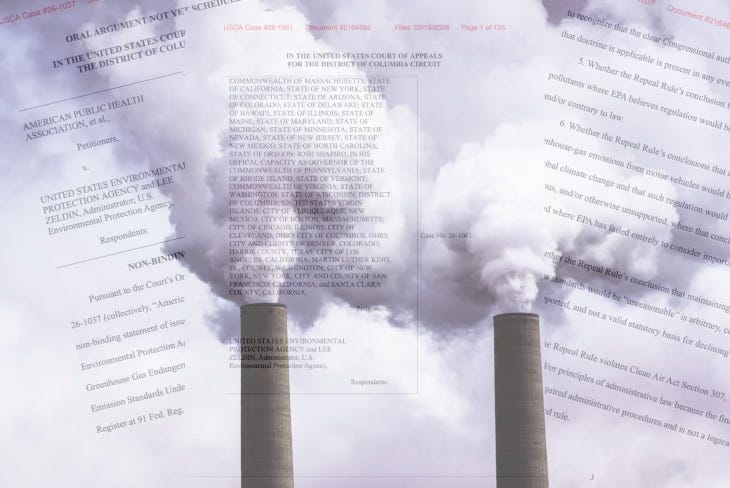
A huge coalition of Democratic-led states and cities has joined the legal fight challenging the Trump administration’s repeal of the 2009 endangerment finding, a rule that formed the legal basis for a large swath of American climate regulations.
The lawsuit filed Thursday in the D.C. Circuit Court of Appeals is at least the second to target the Environmental Protection Agency’s February decision to repeal the finding, which originally held that six greenhouse gases including carbon dioxide threaten public health.
The latest effort — led by Massachusetts on behalf of 24 states, 12 municipalities and other governments — marks an inflection point in one of the biggest legal fights that will take place in the second Trump administration.
The heaviest hitters are now all in the arena. And legal experts expect the case to head to the Supreme Court.
“Climate change is real, and it’s already affecting our residents and our economy,” Massachusetts Attorney General Andrea Joy Campbell said.
The office she now leads spearheaded the legal challenge that ultimately forced the government to create the endangerment finding two decades ago.
“When the federal government abandoned the law and the science, everyday people suffer the consequences.”
The EPA’s argument
The endangerment finding is a key regulatory determination that greenhouse gases like carbon dioxide and methane pose a threat to human health and therefore must be regulated under the Clean Air Act (CAA).
It was finalized by the Obama administration in 2009 after years of litigation, which culminated in the Supreme Court’s landmark 2007 decision in Massachusetts v. EPA. That ruling clarified that greenhouse gases qualify as pollutants under the CAA and directed the EPA to determine whether they endanger public health and welfare.
When it finalized the repeal in February, however, the EPA said it had determined that the 2009 rule exceeded the agency’s authority under the CAA.
While that sounds like a contradiction, the Trump administration argued the CAA only addresses regional pollution — not carbon emissions on a global scale — and further determined that eliminating greenhouse gas emissions from American vehicles would have a negligible impact on climate change.
In other words, the EPA’s position boils down to its determination that reducing one of the biggest sources of greenhouse gas emissions on the planet wouldn’t directly solve climate change. And regulations to curb emissions “would be unreasonable given their futility and the immense burdens they place on regulated parties, consumers and the economy.”
The agency reached its conclusion in part by applying the Supreme Court’s “major questions doctrine,” which is a legal principle that says agencies cannot regulate matters of vast economic or political consequence without clear authorization from Congress.
That doctrine was significantly advanced in the Supreme Court’s 2022 decision in West Virginia v. EPA, which invalidated an Obama-era climate regulation addressing power plants.
The EPA also argued that the court’s earlier reading of the CAA allotted the EPA too much interpretive discretion. Under the recent Loper Bright Enterprises v. Raimondo Supreme Court decision, the courts said that judges — not executive agencies — are best to determine the meaning of laws when they are unclear or ambiguous.
Sharmila Murthy, a law professor at Northeastern University School of Law, told Landmark she isn’t convinced that the EPA’s efforts to reframe the endangerment finding in light of the major questions doctrine or the Loper Bright decision on discretion will stand.
The Supreme Court has already clearly addressed the issue, she said.
“The Supreme Court, in Massachusetts v. EPA, found that the text of the Clean Air Act was unambiguous and that the ‘sweeping definition’ of ‘air pollutant’ included greenhouse gases,” Murthy said. “The court did not rely on … deference.”
What does the Clean Air Act say?
While the endangerment finding most directly relates to Section 202 (a) of the CAA, which regulates emissions from cars and trucks, the finding has been used to justify virtually every major climate rule in the U.S., including rules to rein in power plant emissions.
The law does not explicitly make a distinction between global and regional pollution, as the Trump administration has now done. The EPA did not challenge the overwhelming science that shows climate change poses numerous risks to the health and safety of people across the country, and the globe.
While Massachusetts and its fellow challengers did not lay out a legal argument in the lawsuit they filed, a similar coalition had rejected the Trump administration’s legal rationale in comments submitted during the rulemaking process.
They said that the CAA “clearly directs that greenhouse gases are pollutants,” adding that the Supreme Court “unequivocally held that greenhouse gases are air pollutants subject to” the law in Massachusetts v. EPA.
The arguments are similar to those that have been presented by environmental groups that sued within days of the endangerment finding repeal being announced.
A group of young people have also challenged the decision in court, arguing the EPA’s decision violates their constitutional rights to life, liberty and religious freedom “by unleashing pollution that injures their fundamental rights when the agency’s singular job is to control and limit pollution harmful to their lives.”
(Note: Landmark’s previous analysis of the legal arguments can be read more in-depth here.)
‘Tortured legal acrobatics’
The litigation will first proceed in the D.C. Circuit, before potentially landing in the Supreme Court.
While the D.C. Circuit is viewed as a favorable venue for the challengers, legal experts told Landmark that there are some behind-the-scenes legal dramas to pay attention to. The first is that the timeline of the case will matter quite a bit.
President Donald Trump has nearly three years left in his term, which means plaintiffs have an incentive to drain the clock as long as possible. That strategy would bank on the belief that a president who wants to keep the endangerment finding around will replace Trump in 2029, and immediately reconsider the repeal.
If that happens before the case advances to the Supreme Court, the high court may never have the opportunity to consider the Trump EPA’s legal arguments.
Patrick Parenteau, a professor emeritus at Vermont Law and Graduate School, told Landmark that “it is not clear this is going to get to SCOTUS before the clock runs out on Trump.”
He added that the D.C. Circuit could vacate and remand the rule for any number of reasons before getting to the substance of the endangerment finding’s legality. Notably, the court could find issues with how the EPA went about vacating the endangerment finding in violation of the procedural requirements of the Administrative Procedure Act.
“The only way for Trump to score a quick victory is to get a favorable decision out of the D.C. Circuit and have SCOTUS” refuse to take the case, he said. “I don’t see any plausible scenario for that to happen.”
Parenteau also isn’t convinced that the votes to uphold the Trump administration’s deregulatory move are there. But not everyone shares his confidence.
Joe Goffman, who was assistant administrator in the Biden administration’s Office of Air and Radiation, told Landmark that the EPA has given conservatives on the court “enough to work with,” depending on what the conservative justices want to do.
“If the answer is they want to reverse or de-commission Massachusetts v. EPA, which I believe is what they want to do, then the strength or weakness of the agency’s arguments as well as the court’s commitment or lack thereof to stare decisis is irrelevant,” he said.
But he and others said that the EPA’s position is a perversion of the Clean Air Act, no matter how they dress it up.
“What’s provocative about this entire effort is the sheer perversity of the administration’s position, and what I fear the court’s ultimate position will be,” Goffman said, noting that the decision appears to be a desperate effort to undermine the growing momentum behind electric vehicles and clean energy technology.
“What we’re seeing is tortured legalistic acrobatics” aimed at undermining that momentum, he said.