



The Standing Rock Sioux Tribe has filed a new lawsuit asking a federal judge to shut down the Dakota Access pipeline, which received final approvals this year that nearly doubled its oil flow capacity despite fears that a rupture would devastate the tribe’s drinking water.
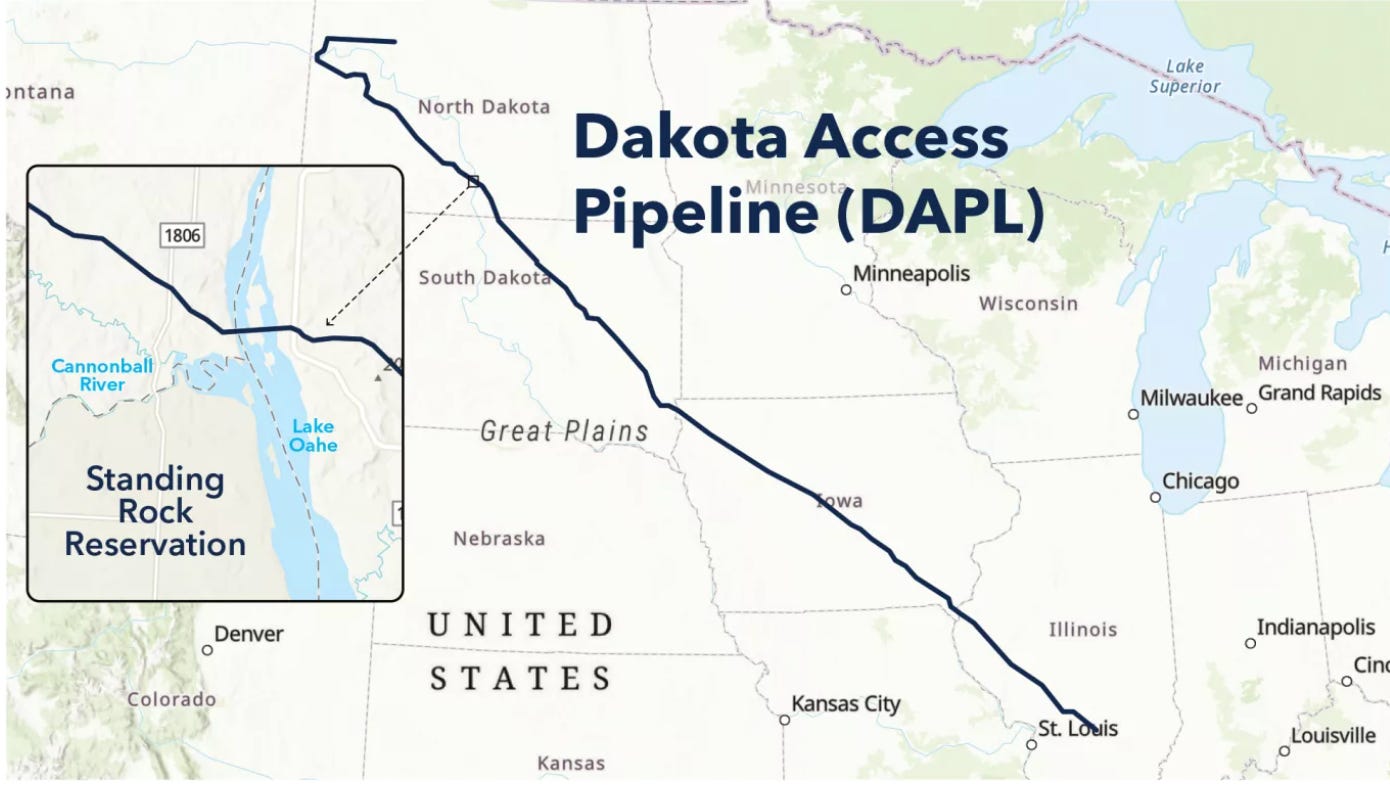
The lawsuit filed in the U.S. District Court for the District of Columbia on Friday against the Army Corps of Engineers and the Pipeline and Hazardous Materials Safety Administration is the latest in an over-decade-long saga. The crude oil pipeline spans 1,174 miles from oil fields of western North Dakota to Illinois, and runs under the tribe’s sole source of drinking water.
“For ten years, Standing Rock’s concerns about this pipeline have not changed, and for ten years we have fought to protect our water, our Treaty rights, and our people. The Army Corps has now chosen to move forward without addressing those concerns,” Standing Rock Sioux Tribe Chairman Steve Sitting Bear said in a statement provided to Landmark.
The tribe is seeking to vacate the Corps’ May record of decision approving a 25-year easement that allows the pipeline to cross under Lake Oahe. The lawsuit said the government’s review significantly underestimated the likelihood that the line could rupture under a lake providing the tribe with drinking water — and overestimated the ability to contain a rupture if it did.
The latest approvals increased the pipeline’s flow capacity to 1.1 million barrels a day, from the original 570,000.
The lawsuit alleged the government violated the National Environmental Policy Act, the Administrative Procedure Act and other laws in finalizing its review and approval.
A decade of controversy and legal skirmishes
The Dakota Access pipeline has been a source of controversy since it was first proposed by the developer and pipeline operator Energy Transfer in 2014. It drew national media attention after police and militarized security forces faced off with demonstrators who began protesting its construction in 2016 from a camp in southern North Dakota.
The project required a complicated maze of state and federal permitting, which included the Lake Oahe easement and a series of general permits for water crossings along the full route.
After U.S. District Judge James Boasberg in D.C. denied a request to stop the pipeline’s construction, the project began shipping oil in 2017. Prior to its launch day, President Donald Trump had issued a memo pushing for the pipeline’s completion. Doug Burgum, who was then the governor of North Dakota but is now the Interior Department secretary, has also been a prominent supporter.
The latest lawsuit follows a separate order by Boasberg that instructed the Army Corps in 2020 to take a new look at the project after determining the initial environmental review left “serious and unresolved” concerns over the pipeline’s leak-detection capabilities, Energy Transfer’s safety record, plans for recovering oil under winter ice and calculations for a potential worst-case spill.
Boasberg later ordered the pipeline be shut down pending the review, but an appeals court reversed that decision to block its operation as the review took place. Energy Transfer said at the time that it could lose billions of dollars if the pipeline were forced to shutter.
Energy Transfer and the Army Corps didn’t immediately respond to requests for comment. The Pipeline and Hazardous Materials Safety Administration, which approved response plans that the tribe said are deficient, also didn’t respond to a request for comment.