


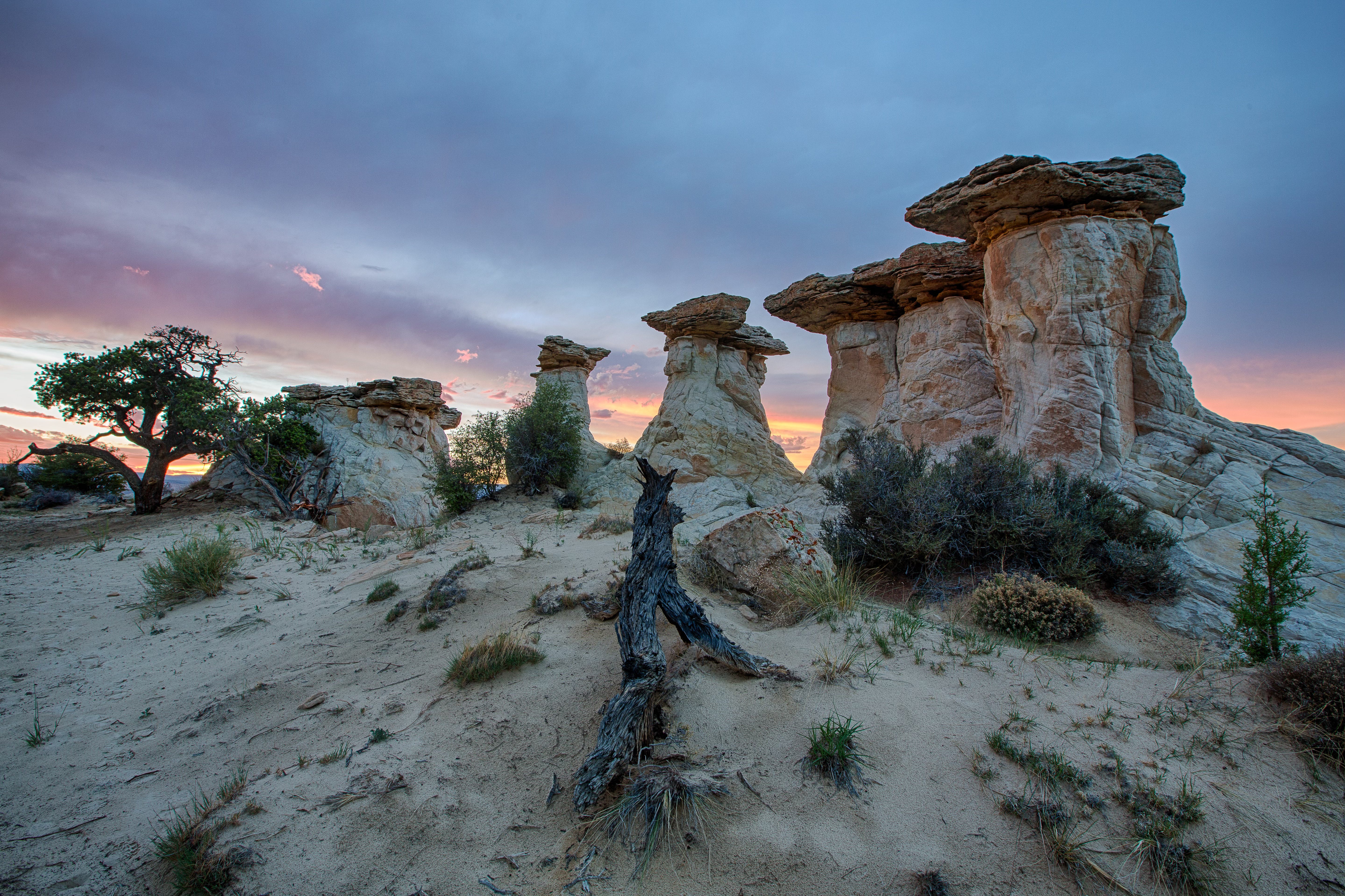
President Donald Trump signed proclamations on Monday that drastically reduce the acreage of two national monuments in Utah, prompting environmental groups to promise that they will quickly challenge the moves in court.
Trump’s decision cuts the size of the Grand Staircase-Escalante and Bears Ears National Monuments by a combined nearly 3 million acres, which in practice means that a large swath of Utah land has lost protections against mining, logging and other development.
The president even boasted that the reductions were bigger than the cuts he made during his first term, when he slimmed Bears Ears by 83% and Grand Staircase by 47%.
“We’re actually giving more than we did the first time back to the people of Utah,” he said during a signing ceremony in the Oval Office.
In a release, the White House explicitly tied the move to the president’s broader goals of expanding domestic energy production and “fighting government overreach on public land.”
The administration said that, in addition to cutting national monuments protections, it is working to reduce permitting and review requirements that can stall oil and gas development, as well as timber harvesting.
Heidi McIntosh, a managing attorney at the nonprofit environmental law organization Earthjustice, said they would fight the reductions alongside their partners — just as they did when Trump unilaterally slashed the size of Bears Ears during his first administration.
“The Antiquities Act authorizes presidents to designate national monuments, not to destroy them,” McIntosh said in a statement. “Today’s proclamations are a slap to the face of public lands visitors across the country, as well as the local communities and Tribes that have worked for years to protect these special places.”
The reduction is just the latest time the Trump administration has moved to reduce protections for pristine lands in general. But more specifically, the move will revive that old battle with Earthjustice and others who claim he has no real power to unilaterally reduce national monuments.
National monuments are created by presidents via the Antiquities Act, a 1906 law that was the first American statute to provide general legal protection for cultural, scientific and natural resources on federal lands.
The law has been used by presidents of both parties to protect over 100 national monuments ranging from the 7.7-acre Stonewall National Monument in New York City to islands and reefs in the Pacific Ocean and rock paintings in ancient cliff dwellings in Utah’s Bears Ears.
The outcome of the brewing legal storm is likely to hinge more on what is absent from the Antiquities Act than what it contains. The law specifically gives the president the power to “declare” new national monuments on public land “by public proclamation,” which preserves parcels of land that “shall be confined to the smallest area compatible with the proper care and management of the objects to be protected.”
But it does not say anything about reducing protections. Trump was the first to try to do that during his first term, and the legal battle that ensued never concluded (the case was stayed after President Joe Biden took office and restored Bears Ears to its original size).
The Department of Justice last year drew up a legal memo saying that the president can abolish national monuments under the Antiquities Act. But that conclusion is hotly contested.
“I do think that the Antiquities Act is pretty clear that the act is a one way-ratchet. It’s for designation and expansion,” Susan Jane Brown, a lawyer at the law firm Silvix Resources, told Landmark. “It’s not to diminish the size of existing monuments.”
She added: “There is that provision in the statute that says that the designation needs to be the smallest possible to protect the objects for which the monument is being designated. But if you have objects that cover a big footprint like Bears Ears and Grand Staircase, then the monument is as small as it can be to protect those objects.”
On Monday, Utah Gov. Spencer Cox addressed those concerns directly, arguing that Bears Ears and Grand Staircase are sprawling portions of his state that go well beyond the “smallest possible” provision of the Antiquities Act.
“It’s very clear that these monument designations are supposed to be the smallest area possible to protect the antiquities, and these multi-million-acre monuments that are bigger than the state of Delaware certainly do not fit that designation,” he said during a signing ceremony in the Oval Office alongside Trump.
The critique appears to have at least some sway with Supreme Court Chief Justice John Roberts as well, who wrote in 2021 that the “smallest area compatible” restriction “has ceased to pose any meaningful restraint.”
“A statute permitting the president in his sole discretion to designate monuments ‘landmarks,’ ‘structures,’ and ‘objects’... has been transformed into a power without any discernible limit to set aside vast and amorphous expanses of terrain above and below the sea,” he wrote.
John Leshy, a law professor at the University of California Law in San Francisco and former Interior Department general counsel during the Clinton administration, isn’t convinced that cutting back national monuments will be a hugely popular decision.
He told Landmark that national monuments are typically very popular among the general public, or they quickly become popular if they attract initial backlash.
“You have uranium guys who don’t like Bears Ears. And there are, from time to time, local ranchers who don’t like national monuments even though they generally preserve ranching,” Leshy said. “People don’t like the feds and the president coming in and telling us how we should manage lands.”
“But outside of a handful of areas in the West, the monuments done in the past 20 or 30 years have been very popular,” he said.
In fact, many are so popular that Congress has later upgraded their protections, turning national monuments into what are now known as the Grand Canyon, Acadia, Olympic, Arches and Zion National Parks.
Today, approximately half of American national parks were first national monuments.
“Given all the efforts the second Trump Administration has been taking to open the public lands to speculation and plundering by special interests at the expense of ordinary people, this latest move is not surprising,” Leshy said.
“But I think many of those ordinary folks who live in the region will be particularly unhappy because they enjoy these protected lands, and regard them as contributing a lot to the quality of their lives.”
Callous greed of the few is unsustainable. We must continue every legal action to thwart this blindness.
I fear that roberts will get his way here when the lawsuits in this case land at SCOTUS. Would it be more prudent to suspend suits until the admin changes? I just don’t know anymore