


A federal judge has rejected the Justice Department’s effort to preemptively kill a Michigan climate lawsuit, repurposing a previous Supreme Court decision that gave the first Trump administration room to try to exclude undocumented immigrants from the 2020 Census.
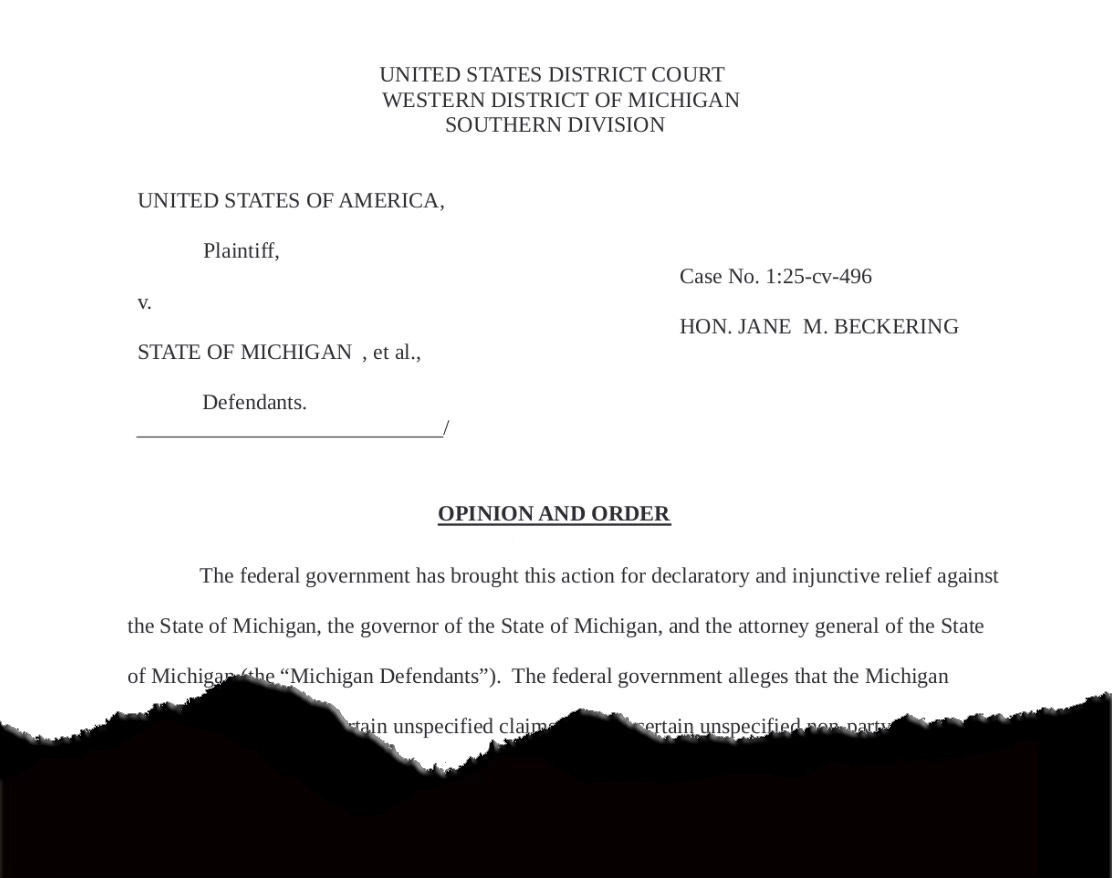
U.S. District Judge Jane Beckering, a Biden appointee, dismissed the DOJ’s lawsuit on Jan. 24 after finding the lawsuit was too speculative, since Michigan hadn’t actually filed a climate change lawsuit when the federal government tried to step in.
While Michigan had eventually filed the type of lawsuit the DOJ feared — a lawsuit claiming major oil and gas companies colluded to undermine renewables development, filed just a day before Beckering’s decision — the judge said the state had only begun to talk to outside firms and consider a lawsuit when it was sued last year.
“The federal government has failed to cite any case in which a court has preemptively enjoined a party from bringing a broad swath of unspecified claims against unspecified members of a given industry simply because that party has begun investigating whether a litigation strategy may have merit,” Beckering, a judge for the U.S. District Court for the Western District of Michigan, said.
The DOJ didn’t immediately respond to a request for comment.
A Trump win turns sour for the administration
In her decision, Beckering repeatedly cited previous preemption cases to determine that the DOJ climate suit wasn’t yet ripe for judicial review, and that the federal government didn’t have standing for lack of concrete harms.
Among those cases she cited was a case in which paint manufacturer Sherwin-Williams tried to preemptively shield itself from lead paint liability. But Beckering repeatedly returned to the Supreme Court’s 2020 decision in Trump v. New York.
“The threat that at some point Michigan might bring a lawsuit that would somehow adversely affect oil company finances, which in turn would have some conceivable impact on U.S. policy, was nowhere even close to meeting those requirements.”
In that case, the high court’s conservative majority said that a lawsuit filed by a coalition of Democratic-led states and non-profits challenging the first Trump administration’s plan to exclude undocumented immigrants from the calculations used to allocate seats in the House of Representatives was premature.
While President Donald Trump had issued a memo during his first term stating that the government would exclude those individuals from the Census, the high court’s conservative majority said that the specifics of how the order should be executed had not been revealed or implemented, and so the case was unripe.
(Note: The first Trump administration eventually abandoned the effort after a second lawsuit was filed by the plaintiffs in that case. The Supreme Court’s three liberal justices dissented in the Trump v. New York decision).
Daniel Farber, a law professor at UC Berkeley Law School, told Landmark that there is nothing unusual about a judge citing precedent — past case reasonings inform evolving legal doctrine —- but said he is “sure that the judge wasn’t oblivious to the irony of using Trump v. NY against the administration.”
The high court’s “reasoning in Trump v. NY was a nice illustration of a larger point: to have standing, the plaintiff needs to show a concrete injury and a clear chain of causation,” Farber said.
“The threat that at some point Michigan might bring a lawsuit that would somehow adversely affect oil company finances, which in turn would have some conceivable impact on U.S. policy, was nowhere even close to meeting those requirements,” he added.
Trump’s crackdown on climate in courts and elsewhere
Soon after taking office in January 2025, Trump began to aggressively pursue policies to help support the fossil fuel industry.
The administration has made it easier to drill on public lands, issued permits to make it easier to ship natural gas overseas and recently oversaw regime change in Venezuela in the name of opening up that country’s oil reserves to American companies.
The fossil fuel industry has also been pushing Congressional Republicans to pass a law shielding them from legal liability for climate change harms. The American Petroleum Institute, a prominent trade group that is often at the heart of climate change lawsuits filed by states and local governments, has identified that immunity as a top priority for 2026.
The Trump administration’s pre-emption lawsuit against Michigan was one of two cases, alongside another against Hawaii, that were filed in late April to more directly shield the industry from those cases.
Two other cases were filed by the DOJ a day later against New York and Vermont challenging their climate Superfund laws, and legal experts said at the time that all four were highly unusual if not unprecedented.
Hawaii filed a lawsuit against the fossil fuel industry just a day after the DOJ sued.
There are currently 11 U.S. states and dozens of city, county and tribal governments with active lawsuits against major oil and gas companies, according to the Center for Climate Integrity. They broadly claim the industry should be held accountable for intentionally deceiving the public for decades about the climate change harms of oil and gas use.